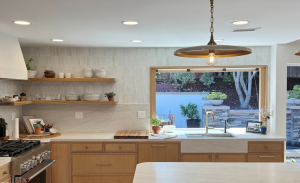
Exploring the Many Names for One of Today’s Most Innovative Window Designs
If you’ve spent any time recently browsing modern homes, restaurants, or architectural design portfolios, you’ve probably seen this window.
It opens outward and upward.
It creates a dramatic indoor–outdoor connection.
It turns kitchens, bars, and living spaces into flexible entertaining hubs.
And yet… no one seems to agree on what to call it.
This increasingly popular window type goes by many different names, each highlighting a specific feature, use, or mechanism. In this article, we’ll explore the most common terms, why they exist, where they fall short, and why “Strut Windows” may be the most accurate and future-proof name for this innovative design.
“Servery Window”
The term servery window is one of the more charming names in circulation.
It clearly references one of the most popular applications: serving food and drinks from a kitchen to an outdoor patio, bar, or entertaining area. The name feels intentional and design-driven, and it has gained traction in residential and hospitality projects alike.
The limitation:
While serving is a common use, it’s far from the only one. These windows are also used for:
- Ventilation and daylighting
- Visual connection between spaces
- Retail and café storefronts
- Architectural statements
Many window types can technically function as “servery windows,” so the name focuses more on how the window is used rather than what it is.
“Flip Up or Flip Out Window”
Similar to servery, the terms flip up and flip out windows are catchy and descriptive. This name aids in visualizing how these windows open and may be useful conversationally for those not as familiar with this type of window.
The limitation:
These products are primarily being used in luxury residential and commercial applications. Some say these names lack the sophistication a highly engineered product designed for luxury applications should have. It could set an expectation for lower quality product or lack luster customer experience.
“Pass Through Windows”
This name takes a broader, more functional approach.
A pass through window describes exactly what it does at a high level: it allows people, food, or objects to pass from one space to another. From a usability standpoint, that’s accurate and intuitive.
The limitation:
The problem is specificity. Sliding windows, bi-fold windows, and even traditional double-hung windows can all function as pass-throughs. As a product name, it doesn’t clearly define the design or operating style.
“Pass Through Awning Window”
Adding awning window to the mix improves things.
This term starts to describe the actual window type — hinged at the top and opening outward. It narrows the field and gives architects and designers a better sense of what to expect.
The limitation:
It still centers the idea of “pass through,” which is only one of many possible applications. The window’s architectural value, structural innovation, and flexibility extend well beyond that single function.
“Hydraulic Windows” / “Hydraulic Awning Windows”
This name shifts the focus away from application and toward engineering — a step in the right direction.
At first glance, “hydraulic window” suggests strength, control, and smooth operation. It’s often used to describe large, top-hinged windows that open upward with assistance.
The limitation:
Most of these windows don’t actually use hydraulics.
In reality, they are typically operated by:
- Pneumatic (gas) struts for manual operation
- Electric actuators for automated or motorized systems
While the name sounds technical, it’s not technically accurate.
“Gas Strut Windows” / “Gas Strut Awning Windows”
Now we’re getting closer.
This terminology uses correct mechanical language and accurately describes how many manually operated versions of this window function. Designers and engineers appreciate the precision here.
The limitation:
A growing percentage of these windows are automated. By focusing solely on gas struts, this name unintentionally excludes motorized and electronically actuated versions of the same design.
“Strut Windows” (and “Gravity Strut Windows”)
This is where everything comes together.
Strut Windows is a simple, flexible, and accurate term that:
- Describes the design, not just one use
- Avoids limiting the window to “pass through” scenarios
- Applies to both manual and automated systems
- Feels architectural, modern, and intentional
By referencing the strut-assisted operation without over-specifying the mechanism, the name leaves room for innovation while remaining technically honest.
At Gravity Windows, we often use the term Gravity Strut Windows to further emphasize how these windows are balanced, supported, and effortlessly operable — even at large sizes.
Why Naming Matters in Architecture and Design
Words shape expectations.
For architects and designers, a name should:
- Clearly communicate intent
- Avoid locking a product into a single use
- Feel timeless, not trendy
For homeowners, it should feel intuitive, aspirational, and easy to understand.
Strut Windows strike that balance — a name that reflects how the window works, how it feels to use, and how naturally it integrates into modern design.
One Window. Many Names. One Clear Direction.
As this window type continues to grow in popularity across residential, hospitality, and commercial projects, the language around it will continue to evolve.
But if the goal is clarity, flexibility, and design accuracy, Gravity Strut Windows may be the name that finally sticks.